Learn
Discover the World's First Monotheistic Religion
A simple introduction to Zoroastrianism — its origins, beliefs, practices, and festivals. Whether you're new to the faith or deepening your understanding, start here.
Zoroastrianism
Zoroastrianism is one of the world's oldest continuously practised religions, founded by the prophet Zarathushtra in ancient Iran over 3,000 years ago. Its core message is simple and timeless: choose righteousness through Good Thoughts, Good Words, and Good Deeds.
The faith has profoundly influenced Judaism, Christianity, and Islam — concepts like heaven and hell, angels, and a final judgment all trace back to Zoroastrian teachings.
Today, Zoroastrians — often called Parsis in South Asia — number around 100,000–200,000 worldwide, with communities in Iran, India, North America, Europe, and beyond. Despite their small numbers, their cultural and religious contributions have shaped civilization immeasurably.
0 1
Dates & Origins
The founder of Zoroastrianism, Zarathushtra, or Zoroaster as the Greeks rendered the name, cannot be ascribed any precise date. Academic opinion suggests a date roughly around 1300 BCE. Three Iranian empires spanning about 1000 years subscribed to and practised Zoroastrianism before the advent of Islam.
0 2
Zoroaster's Message
Zoroaster's message centres on the cosmic struggle between Asha (Truth/Righteousness) and Druj (Falsehood/Deceit). He taught that every individual has the free will to choose between good and evil, and that through Good Thoughts, Good Words, and Good Deeds, humanity can promote Asha.
0 3
The Symbolism of Fire & Prayers
Fire holds a central place in Zoroastrian worship as a symbol of Ahura Mazda's light and truth. It represents the divine spark within each person. Zoroastrian prayers are recited in Avestan, the ancient language of the sacred texts.
0 4
Gender Equality
Zoroastrianism has always championed equality. Zarathushtra himself addressed both men and women equally in his Gathas. The religion teaches that gender does not determine spiritual worth.
Good Thoughts, Good Words, Good Deeds
The core ethical triad of Zoroastrianism — Humata, Hukhta, Hvarshta — guides every aspect of daily life and moral decision-making.
Ahura Mazda
The one uncreated God, the supreme being of wisdom and light. Zoroastrians worship Ahura Mazda as the creator of all good things.
The Battle of Good and Evil
Zoroastrianism teaches that the universe is a battleground between Asha (truth/righteousness) and Druj (falsehood/chaos).
The Avesta
The primary collection of sacred texts, including the Gathas — hymns believed to be composed by the prophet Zarathushtra himself.
Frashokereti
The final renovation of the universe, when evil is defeated, the dead are resurrected, and all souls are purified to dwell with Ahura Mazda in perfection.
Free Will
Each person is endowed with free will and is responsible for choosing good over evil. Zoroastrianism rejects the concept of predestination.
The Sudreh & Kusti
Every Zoroastrian wears the Sudreh (sacred inner shirt) and Kusti (sacred cord) after their Navjote. The Kusti is untied and retied during daily prayers as a reaffirmation of faith.
Daily Prayers
Zoroastrians pray five times a day (the five Gahs) facing a source of light. Prayers are recited in Avestan and include the fundamental Ashem Vohu and Yatha Ahu Vairyo.
Fire Temples
Atash Behrams (highest grade), Atash Adaran, and Atash Dadgah house sacred fires of different grades. The fire must be continuously maintained and is never extinguished.
Navjote Ceremony
The initiation ceremony, typically performed between ages 7–15, where a young person formally enters the Zoroastrian faith.
Purity Rituals
Cleanliness of body, mind, and spirit is central to Zoroastrian practice. Various purification rituals (Nahn, Bareshnum) prepare individuals for sacred rites.
January / February
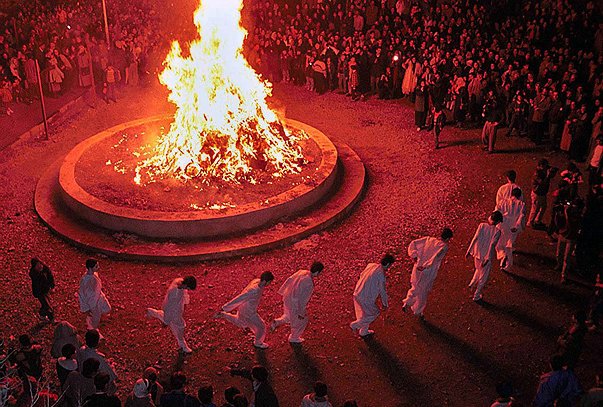
Sadeh
Festival of fire, commemorating the discovery of fire. Large bonfires are lit to symbolize the triumph of warmth and light in the coldest days of winter.

Spring Equinox (March)
Nowruz
The Zoroastrian New Year, celebrating renewal and the triumph of light over darkness. Families gather to set the Haft-Sin table and welcome the new year.

July
Tirgan
A midsummer celebration of water and rain, honoring the angel Tishtar. Communities gather near rivers and pour water on one another in joyful celebration.

October
Mehregan
Festival of Mithra, celebrating love, friendship, and harvest. A time for feasting, giving thanks, and strengthening bonds within the community.

Winter Solstice (December)
Yalda / Shab-e Chelleh
The longest night of the year, celebrated by gathering with family, reciting poetry, and eating pomegranates and nuts until dawn.

Last 10 Days of the Year
Farvardegan
Days of remembrance for departed souls. Prayers are offered and homes are cleaned to welcome the Fravashis — the guardian spirits of ancestors.
Read more
© 2026 The World Zoroastrian Organisation Ltd. Registered charity in England & Wales no. 1023334. All rights reserved.
Powered by Voltik.ai